What if the most important click you make in the wallet isn’t “Confirm” but “Simulate”? For DeFi power users who regularly route trades, grant approvals, and interact with dozens of smart contracts across networks, transaction simulation and pre-signature risk scanning are not niceties — they’re operational controls. This article compares Rabby Wallet’s extension-led approach with common alternatives, explains the mechanisms behind its safety features, surfaces realistic limits, and gives practical heuristics for when Rabby is a strong fit and when another tool might be preferable.
The comparison centers on three questions readers care about: how the security model works in practice, what trade-offs multi‑chain convenience introduces, and how Rabby’s features change decision-making for active DeFi operators in the US ecosystem.
How Rabby’s security stack works — mechanism, not marketing
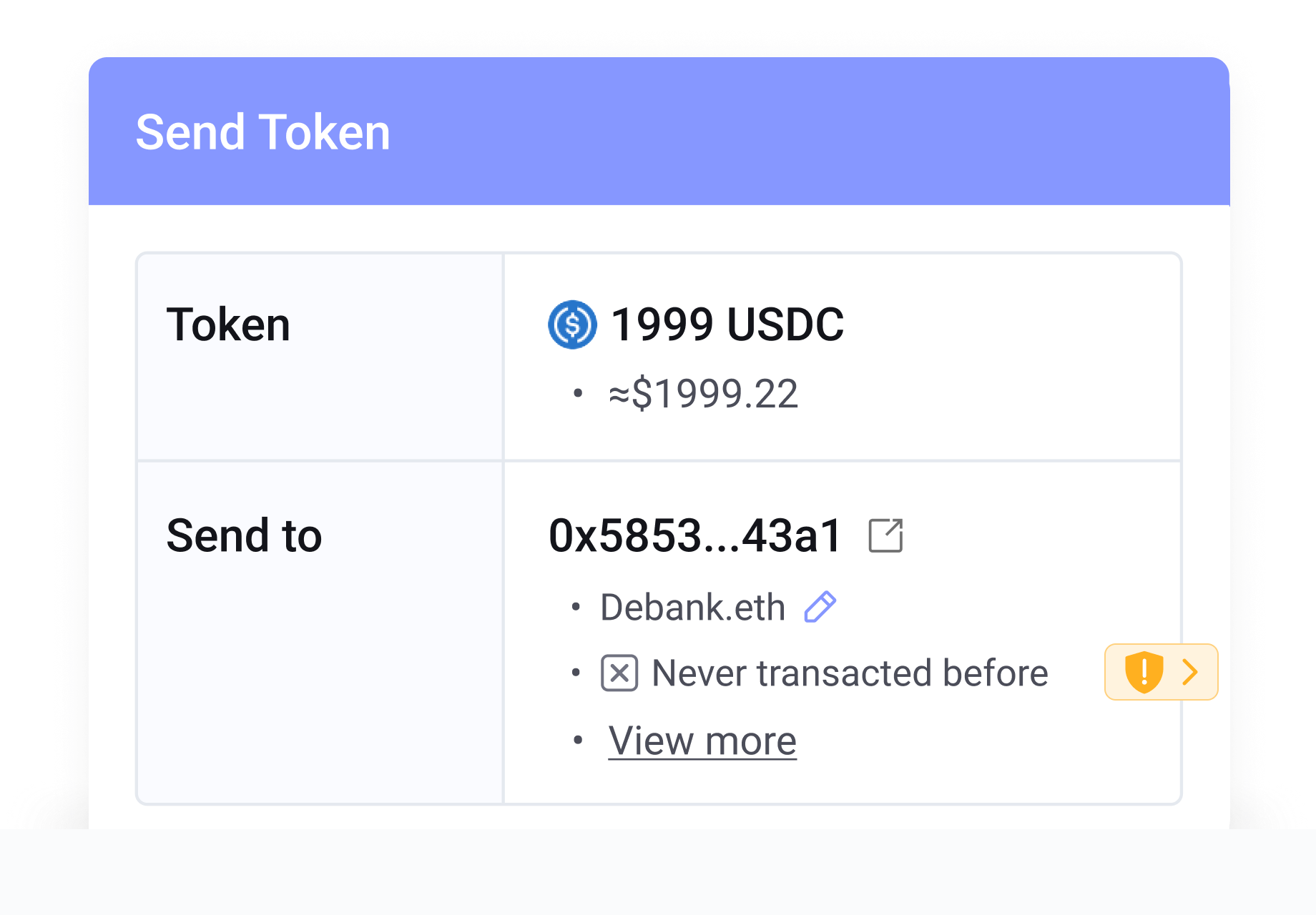
At its core Rabby is a non‑custodial wallet built by DeBank and available as a Chromium browser extension, mobile app, and desktop client. Two mechanisms distinguish its extension experience: transaction simulation and pre‑transaction risk scanning. Simulation executes a dry‑run of the intended transaction against a local or hosted node to produce concrete outputs — estimated balance changes, token transfers, and fee costs — before you sign. The risk scanner cross‑references known bad indicators (previously exploited contracts, suspicious approval requests, and invalid recipient addresses) and surfaces alerts before the signature step.
These are mechanistic protections: simulation reduces “blind signing” by replacing promise or label-based checks with deterministic state evaluation; the scanner provides heuristic filters trained on observable incident patterns. Together they shift the failure mode from “I didn’t know what I approved” to “I understood the consequence and accepted it.” For active traders and protocol integrators, that shift is meaningful because it converts a class of human errors into informed operational choices.
Side‑by‑side: Rabby vs typical alternatives (MetaMask, Trust Wallet, Coinbase Wallet)
Three comparison axes matter most for power users: pre‑sign security, multi‑chain workflow, and enterprise readiness.
Pre‑sign security — Rabby simulates and flags risky elements; MetaMask and many mobile wallets generally show call data and require the user to infer consequences. That means Rabby reduces cognitive load and the likelihood of approving malicious approvals, but simulation depends on accurate node state and up‑to‑date heuristics. It’s a powerful mitigation, not an absolute guarantee.
Multi‑chain workflow — Rabby supports over 90 EVM chains and auto‑switches networks when a dApp requires it. The convenience is clear for traders operating across Arbitrum, Optimism, Polygon, BNB Chain and others: fewer manual switches, fewer accidental wrong‑chain approvals. The trade‑off is surface area: a broader attack surface for UI‑level phishing or malicious dApp prompts, so the wallet’s automatic switching must be combined with user vigilance and host OS/browser security.
Enterprise and institutional use — Rabby integrates with Gnosis Safe, Fireblocks, Amber, and Cobo, and supports hardware devices (Ledger, Trezor, Keystone, CoolWallet, GridPlus, BitBox02). This makes it suitable for multi‑sig treasury workflows where human review plus hardware signatures are required. By contrast, consumer wallets may lack the same enterprise connectors or polished multi‑sig UX.
Where Rabby materially reduces common myths and errors
Myth: “If I read calldata I’m safe.” Reality: calldata is dense and often opaque; simulation translates calldata into human‑readable balance movements and fees. That’s not foolproof (coder‑level attack vectors still exist), but it reduces a frequent human failure: approving ERC‑20 allowances without understanding downstream token flows.
Myth: “Auto network switching is risky because it hides the network.” Reality: it can be risky if you assume the wallet made a correct choice, but it also prevents a common operational error — signing on the wrong chain. The safer pattern is to treat auto switching as a convenience with verification: glance at the simulated balance changes and network label, especially when interacting with high‑value contracts.
Known limits and realistic failure modes
Rabby’s strengths come with clear boundary conditions. First, simulation accuracy depends on the node’s view of chain state, gas dynamics, and the dApp’s on‑chain randomness. For reentrancy or complex cross‑contract interactions, simulations can miss transient conditions or subtle exploitable race windows. Second, open‑source transparency and audits reduce but do not eliminate software risk; Rabby’s 2022 swap contract exploit (about $190k) is a concrete reminder: a wallet operator can implement strong user protections but still be affected by vulnerabilities in associated contracts. The team’s response — freezing the contract and compensating users — is informative about governance and remediation but does not erase systemic exposure.
Third, Rabby lacks a built‑in fiat on‑ramp and native staking flows. For US users who want an all‑in‑one on‑ramp, this means pairing Rabby with an exchange or third‑party service. Fourth, multi‑chain convenience increases the importance of device hygiene: browser isolation, hardware wallet use for larger balances, and a disciplined process for imports and seed management are still essential.
Decision heuristics: when to use Rabby, and when not to
Heuristic 1 — Active DeFi trader or contract integrator: Use Rabby as your primary extension if you frequently interact with new contracts, need automatic network switching, and want simulation to triage approvals. Pair it with a hardware wallet for high‑value operations and enable approval revocation as a routine post‑trade step.
Heuristic 2 — Casual holder or on‑ramp centric user: A mobile-first wallet with fiat rails and simple UX may be better. Rabby’s strengths won’t matter as much if you trade rarely and prioritize buying via bank transfer inside the wallet.
Heuristic 3 — Institutional treasury: Combine Rabby with Gnosis Safe or Fireblocks; use Rabby’s simulation to pre‑approve transaction intent and multi‑sig flows for execution. Keep automated monitoring and an incident response playbook that accounts for contract-level and wallet‑adjacent exploits.
Practical setup checklist for US power users
1) Install the browser extension on a Chromium browser and pin it to avoid phishing popups in hidden extension menus. 2) Import your active trading account or create a fresh account; reserve only operational capital in the hot extension and store long‑term funds in a hardware wallet or cold storage. 3) Enable hardware wallet integration for high‑value signatures. 4) Use the built‑in approval revocation routinely after interacting with DEXes or yield aggregators. 5) Treat simulation as a required habit: always inspect token balance previews and fee estimates before signing. 6) Keep the wallet and browser up to date, and consider a separate browser profile for high‑value DeFi sessions.
What to watch next — signals and conditional scenarios
Three near‑term signals matter. First, continued expansion of EVM chains increases the value of automatic network switching but also raises API/node reliability requirements for correct simulation; a mis‑synced node can produce misleading previews. Second, adoption of standardized pre‑execution simulation APIs by dApps would improve end‑to‑end assurance, turning local dry‑runs into protocol‑level expectations. Third, regulator attention in the US to on‑chain custody and operational controls could make wallets with strong audit trails and enterprise integrations (like multi‑sig and custodial connectors) more attractive to institutional counterparties. Each scenario is conditional: better UX and standardized APIs would deepen the value of simulation; regulatory shifts could increase demand for enterprise features.
For readers who want to explore Rabby in more depth, the project’s extension and documentation surface these mechanisms clearly; a single convenient reference is the project overview at rabby wallet.
FAQ
Does Rabby eliminate the need for hardware wallets?
No. Rabby reduces some risks through simulation and scanning, but hardware wallets remain the most reliable defense against compromised host environments. For balances that would materially impact you or your organization, use a hardware signer even when using Rabby’s UX.
How reliable are the transaction simulations?
Simulations are conceptually deterministic but practically dependent on node state, mempool timing, and contract complexity. They are highly useful for revealing obvious token flows and fee estimates, but they cannot guarantee protection against race conditions, front‑running, or contract bugs that depend on off‑chain or timing-dependent state.
What happened in the 2022 Rabby Swap incident and what does it teach us?
An exploit in a related swap contract resulted in roughly $190,000 in losses. The developers froze the contract and compensated users. The event underscores that a wallet can mitigate user error but cannot fully insulate users from vulnerabilities in third‑party contracts. Continuous audits, responsible disclosure channels, and remediation plans are essential complements to UX protections.
Is Rabby suitable for institutional custody?
Rabby integrates with multi‑sig and institutional providers like Gnosis Safe and Fireblocks, making it compatible with many institutional workflows. Institutions should evaluate operational controls, audit trails, and integration tests rather than assuming parity with pure custody products.
Trả lời